Showing posts with label 1920s fashion. Show all posts

Wednesday, April 26, 2017

Sewing Patterns Through The Decades: 1920s Style


Hey all!!

It's been a while, I know!  You ever have one of those days?  Or one of those weeks?  Or .. one of those months?

Yeah, we all do.  That's neither here nor there though, let's get on with a blog entry!

I thought it might be fun to roll through the decades and see what kind of fun patterns our Pattern Patter Team members have available from every decade.  Won't that be interesting?

I think so.  Let's get going!
In the 1920s the sewing pattern industry was really getting going.  Patterns had been available for decades before, but new trends in fashion plus new innovations in sewing patterns made it easier than ever to sew for yourself.  You really could have the height of Paris fashion for a much cheaper cost. I'm just speculating here but since more ladies were working in offices and such they may have had more money to spend on things like clothes.


Unbranded Pattern #302

The 1920s are usually considered pretty glamorous (not to mention a total and absolute change from almost everything that ever came before!)  However, this sedate little number shows that style could be simple too.  This unbranded pattern is available from Retroactive Future and is on sale!

Butterick 1771 &  Ladies Home Journal 5250

These two patterns from Kinsey Sue are somewhat similar, with a shoulder drape.  However, the Butterick pattern is slightly more complicated with it's bias cut and asymmetrical neckline which mirrors the asymmetrical flounce at the bottom.

Butterick 1227, 1214

A new addition to my personal collection, this 1920s Butterick advertising sign features lively prints and delicate pleating.  The nautical collar on 1214 is an interesting touch.  Though the lines are straight the amount of ruffles and bows adds femininity.

Australian Home Journal 8376

Though the lines of the 20s seem simple at first glance, look at the complicated lines of this pattern from Sew As It Was Patterns.  Again with a somewhat nautical collar, but the lines down the front are incredibly interesting!  You don't usually see patterns this complicated these days.  This one is from Australian Home Journal so as you can see, this up-to-date fashion was a worldwide phenomenon. :)

Butterick 6365

After a long night of dancing, why not slip into this beautiful robe from Vintage Needle Finds?  Even though it's a robe, it still suggests the straight lines of the late 20s by suggesting you tie it slightly below the natural waist.


From Butterick's Spring 1926 catalog and my personal collection comes this selection of dresses, ranging from very simple to quite complicated.  A hat was still a must as you can see!


Costume parties were big business in the 1920s, with costumes made both of fabric and crepe paper. This Ladies Home Journal catalog from my personal collection features masquerade costumes only, for men, women, and children.  All the major pattern companies had their own masquerade catalogs, including Vogue and Weldon's.

McCall 2833

Pierrot-style clowns were always a favorite... an easy to make costume that could be worn by anyone. This one is in stock at Rebecca's Vintage Salon.

Pictorial Review 1927

These complicated gowns from my personal collection feature very interesting layers and colors.

Pictorial Review 1927

Elegant looks for the bride and her attendants from Pictorial Review and my personal collection.

Pictorial Review 1927

Wow!  Look at the complicated lines on this gown!  I wouldn't want to sew it.  Funny enough, despite the straight lines in the illustration, this is listed as for "the mature figure" with "larger hips."  Haha, I'm not sure how large hips would ever look like that illustration.  (From my personal collection.)

Pictorial Review 1927


How lovely it must have been to wear these simple and comfortable underthings after so many years of being corseted and covered up.  Though many women did wear bust minimizers which squeezed them in for that boyish look.  Couldn't have been comfortable! (From my personal collection.)

Advance 1042

Little girls were often clothed in very short little dresses with a smock-like cut.  Seen here in a very early Advance pattern from The Granny Squared.  Advance patterns from this era seem to be extremely scarce.

Butterick 4433

This bed coat, box coat, or vest is perfect for lounging in the morning.  From Clutterina's Shop.

Butterick 6399

If working with a vintage unprinted pattern is too difficult, or an original 1920s pattern is too pricey, why not try this lovely repro gown from Cloe's Closet?

Leaflet from SoFro Fabrics / House of Fabrics

Or how about this cute DIY leaflet to make your own fringe-covered flapper dress from Denisecraft?

I hope you enjoyed this little stroll through patterns of the 1920s.


Monday, July 13, 2015

All That Jazz


McCall Quarterly, Autumn, 1928
www.studentpulse.com

The conclusion of World War I, the "War to End All Wars", brought dramatic change to the United States as well as other countries.  Soldiers returned home with stories of amazing people and places they had seen and were unwilling to go back to the farm, as the old song says. So much carnage on a world-wide scale had never before been seen.  Young people in particular felt they had to live for the moment since the future is not guaranteed.


from Pinterest

Technology, manufacturing, and customs changed quickly.  The world became smaller as airplane travel was not an unrealistic dream, but a reality.  Automobiles were quickly produced and rapidly sold.  Cars made it possible to travel several states in a single day. Many advertisements targeted women drivers.


1928 Chevrolet ad
from anythingaboutcars.com


ad from The Delineator, 1923
via tumblr.com

Women won the right to vote in 1920 (the 19th Amendment) and never looked back.  They eagerly traded in their corsets, bustles, and voluminous petticoats for freedom of movement.  One could not hop into a car, dance freely, or go to work in such cumbersome attire. 


Actress Louise Brooks wearing a fur trimmed coat and cloche hat 
www.en.wikipedia.com

Hemlines rose, but not overnight.  It wasn't until 1925 that hemlines reached the knee - a perfect length for dancing the Charleston until dawn.  Waistlines had begun to drop in the latter war years and by 1922 settled at the hips.  Because of shorter dress lengths, shoes and stockings became more than a necessity - they became a fashion statement.  Silk stockings were produced in a large variety of colors and patterns.  Shoes, stockings, and dresses became more coordinated.  The most popular style of shoe in this decade was the Mary Jane ankle strap button shoe. 

Montgomery Ward catalog ad, 1920s
via pinterest.com

Sears, Roebuck catalog, 1925
via clickamericana.com

Arms were bared in public, many young ladies openly smoked, and no longer did they retreat to the powder room to apply makeup.  Compacts and cigarette cases from both the 20s and 30s are popular collectibles.


Actress Gloria Swanson
photo by John Abbe, 1921

Bernard Hewitt catalog, 1928
via costumerism.tumblr.com

Another law with far-reaching consequences was also enacted in 1920 - Prohibition.  The Eighteenth Amendment to the Constitution made it  illegal to sell alcohol in the US. It was repealed in 1933. Nightclubs and speakeasies popped up overnight.  It became socially acceptable for men and women to get dressed up, take their new car, and go out dancing and drinking.


Giggle Water cocktail ad, 1928
from pinterest.com


Flappers smoking in a train car
www.smithsonian.com

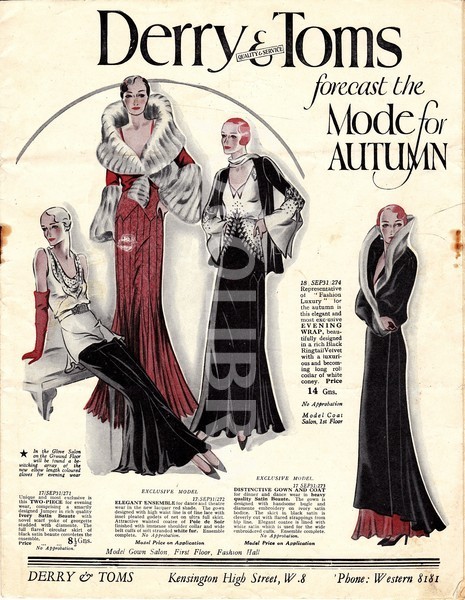
For many, the Roaring 20s was a period of prosperity and elegance. Evening attire in particular was used to show off wealth.  The materials, accessories, headpieces, and shoes were as elegant and expensive as the owner could afford.  Fur coats were standard apparel for women of means.


photo from timetraveler.com


Actress Bebe Daniels, ca. 1927
www.1920s-fashion-and-music-com

Derry & Toms Autumn Fashions, 1928
via www.fotolibra.com


Many famous designers got their beginnings in the 1920s:  Chanel, Lanvin, Patou, Fortuny, Molyneux, and Vionnet are a few of the most well-know names.


via glamourdaze.com
Coco Chanel's "Little Black Dress" was introduced in the 20s

"Jeanne Lanvin invented what was called the robe de style made of velvet and silk.  She often designed this dress in robin's egg blue, a shade which is now known as Lanvin blue." (source: www.1920s-fashion-and-music.com)


1929 Lanvin robe de style, photograph by Granger
Metropolitan Museum of Art

No self-respecting woman appeared in public without a hat, and the cloche is the iconic hat of the 1920s.  Reportedly, Caroline Reboux of France, a milliner, invented it around 1923.  One variation of the cloche dipped lower on one side than the other, giving it a rakish appearance.  

photo from imgarcade.com

The popular cloche has been cited as one of the reasons women began to opt for short hair.  Long hair prevented the cloche from being worn tightly on the head, as it was intended.  Several short hairstyles were popular in the 20s.


Finger Waves
1920s-fashion-and-music.com


Bobbed hair - note the bee sting lips
1920s-fashion-and-music.com


Actress Louise Brooks wearing the Dutch boy
1920s-fashion-and-music.com

Josephine Baker's Eton Crop
photo via huffingtonpost.com
Getty Images

Both day and evening dresses were long, lean, and angular. A boyish figure was sought after - so much so that larger busted women bandaged their breasts or wore a Symington Side Lacer.  This bra could be laced at both sides and pulled tightly.  In essence, it was a corset for the bust.  Other flappers wore a bra which consisted of sections of lace bandeau lined in net.  Underwear was minimal, generally knickers and chemise.  Both were sheer and lightweight.
Sear, Roebuck and Co. ad for stockings
via www.glamourdaze.com


1920s lingerie ad via vintagedancer.com


Several sources state the term "Flapper" originated in Great Britain where there was a short-lived fad of young women wearing unbuckled galoshes. They flapped when walking. The name stuck even after the fad passed and "flapper" evolved to mean a liberated young woman.


Wedding Gown
House of Callot Soeurs design for Edna Johnson 1926
www.larkcrafts.com

The 1920s were flanked on one end by the end of World War I and the other by the stock market crash of 1929. In just eleven short years, America was forever changed.  The image of the flapper is to many the definitive symbol of the Roaring 20s.


photo via meetup.com
by kinseysue on etsy

reference sources:
www.fashionera.com
www.encyclopedia.com
www.1920-30.com 
www.1920s-fashion-and-music.com

Below are some original 1920s sewing patterns, courtesy of the Pattern Patter Team on etsy. 


McCall 4622 from FloradoraPresents; 
Ladies' Home Journal 5947 from allthepreciousthings


Mail Order 6794 from MidvaleCottage; 
Butterick 1741 from VintageNeedleFinds


Pictorial Review 4168 from SelvedgeShop; 
Superior 9064 from DejaVuPatterns
Butterick 1832 from Mrsdepew; 
McCall 4881 from ShellMakeYouFlip


McCall 4987 from kinseysue